

After your lilac blooms fade, do the plant a solid by deadheading
By Jenaleigh Fox
WSU Chelan/Douglas County Master Gardener

Ah, the lilac. The lilac is a much-beloved plant, as evidenced by the number of questions about lilacs that we answer at the Master Gardener Plant & Insect Clinic.
Lilacs are drought-tolerant and hardy plants that do well in our climate. Although it’s not native, it is very much a “right plant for the right place” here in North Central Washington. The scent of the flower takes me right to my grandma’s farmhouse in Wilbur, where she kept bushy lilacs along the path to the front door. I’ve heard many sentimental stories about the lilac, and they’re all as sweet as the plant itself.
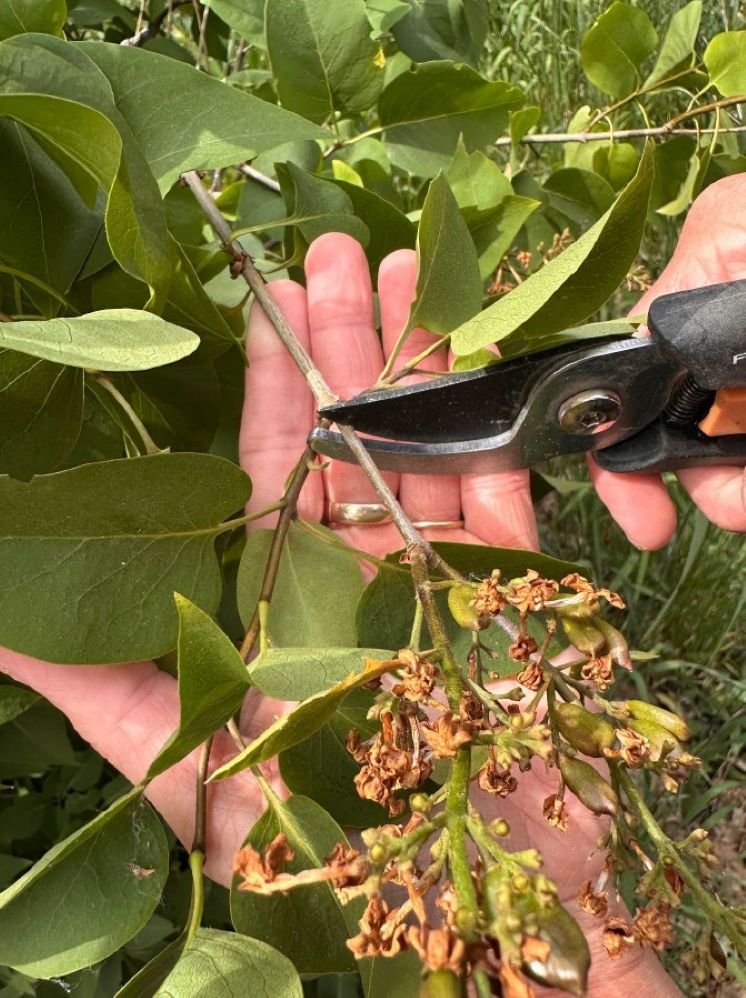
One simple way to care for your lilac now, just after the blooms have faded, is to deadhead the spent flowers.
Deadheading flowering woody plants will halt seed production. When a flower goes to seed, the developing seeds produce hormones that draw the plant’s resources toward themselves and away from other growth. Deadheading removes that hormone production, which frees the plant to put energy toward other kinds of growth.
In the case of lilacs, as well as other spring-blooming shrubs such as rhododendron, viburnum, mock orange and forsythia, the deadheaded plant will have more resources available for setting buds that will bloom the next spring.
Lilacs set buds in the late summer, so to avoid chopping off the growth that will flower next spring, this is also the time to prune your lilac if you would like to train it to be tree-like or if you’d like your lilac to bloom at the optimal height for sniffing. Deadheading and pruning in the weeks after flowering will give your lilac a full summer to grow and set new buds, maximizing next year’s blooms.
If you follow a bud, leaf or branch from its tip down to its base, the place where it attaches to the plant is called a node. Nodes occur along the stems of a plant and often have a knobby, thicker appearance. Nodes are sites of active growth, so when deadheading or pruning, make your cuts just above a node to stimulate new growth. Use clean, sanitized shears, and sanitize between plants. I carry alcohol wipes in my apron to quickly sanitize my gardening tools.
If you’re happy with the shape of your lilac, use a hand pruner to make a cut below the spent bloom and just above the next pair of leaves. While you’re deadheading, you can also cut out any dead or diseased wood. If you’d like to reduce the size of your lilac, use your loppers and cut back to a node just above a side branch at the desired height, or remove larger, older stems at the base (or as low as you can reach). Lilacs naturally send new shoots up from the ground, so to achieve a more tree-like appearance, remove basal shoots yearly.
If you’re pruning once in the spring and still not seeing the blooms you’d like on your lilac, there are a few other considerations. Lilacs do not need a lot of fertilization; nitrogen-rich fertilizers will cause the plant to favor leafy growth over setting buds. Lilacs need at least six hours of sunlight. If your plant is getting less than that, prune the surrounding plants that are shading the lilac, or move it to a sunnier spot. Lilacs that have been recently planted may need 2-5 years before producing reliable blooms as the energy of the plant is directed into root growth.
If you have any questions about your lilacs, or any other beloved plants, email the Master Gardener Plant & Insect Clinic at askamastergardener@chelandouglasmg.org, call us at (509) 421-1864, or visit us every Monday from 1 to 4 p.m. in the Sagebrush Room at the Wenatchee Public Library.
A WSU Chelan and Douglas County Master Gardener column appears weekly in The Wenatchee World. To learn more about your local Master Gardener program, visit bit.ly/wsucdmgprogram or call (509) 667-6540.