

Listen to what your vegetable plants are telling you
By Julie Banken
WSU Chelan/Douglas County Master Gardener

Plants are remarkably honest. If they are suffering in some way, they will let you know. Big trees are frustratingly slow to share their problems; with so many stored resources, they can take years to show signs of stress. By the time symptoms appear, it can be too late to fix what ails them.
Young annual vegetable plants, in contrast, don’t hold back when they are in distress. They have very few resources in reserve, so anything that affects their uptake of water or nutrients will also affect their growth. Because they are almost entirely dependent upon their environment for resources, when they are struggling, it will be obvious.
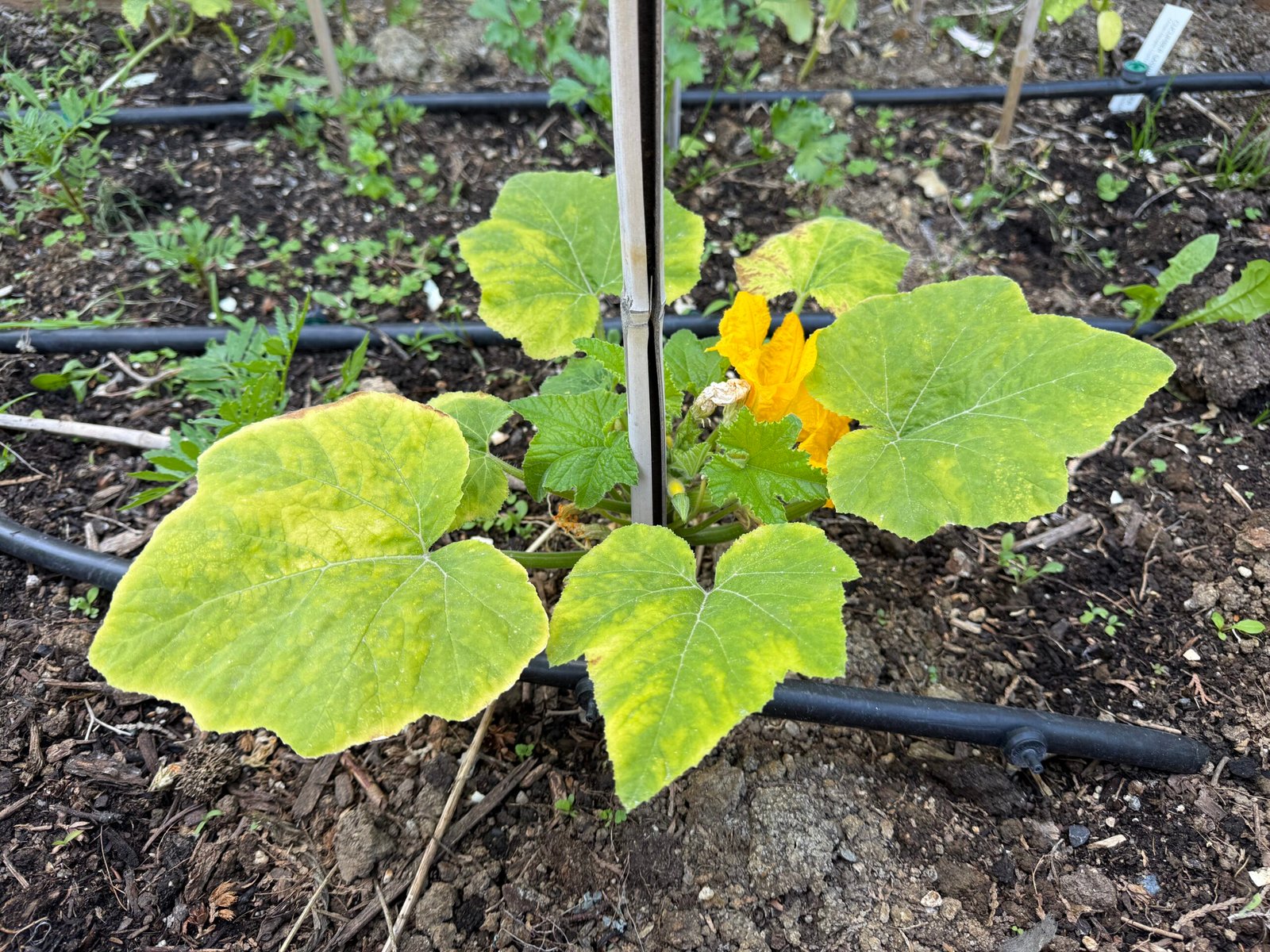
Squash plants such as zucchini are especially vocal about their problems. Right now, mine are practically shouting at me; they are small and anemic and clearly unhappy. One way I can tell is that they are already producing flowers.
Rather than a sign of good health, flowers on a stunted plant can be indicators of stress. When plants commit energy to reproduction early, they are showing that under the current conditions, their only hope is investing in the next generation. They are betting their offspring will have a chance of making it, even if they don’t.
Early blooming, then, is like a flashing light on a car dashboard. You can ignore your plant and hope its problems go away, but it’s a better idea to investigate as soon as you see the warning light.
In a vegetable garden, when plants are telling you something is wrong, pay attention. Fixing problems early can make a big difference in your crop.
Wilting, for example, is your plant’s way of saying it has an acute plumbing problem. When water isn’t being taken up through the roots, turgor pressure drops, causing leaves to flag and stems to droop. Dry soil is the culprit usually, but damaged or overly-wet roots can have the same effect.
Yellowing leaves, or chlorosis, indicate a more chronic problem: your plant is having trouble making enough chlorophyll. Chlorophyll is arguably one of the most important molecules on the planet. It captures the sun’s energy for photosynthesis, allowing a plant to create carbohydrates from water and air.
There are many nutrients involved in making chlorophyll. One of its main components is nitrogen. Nitrogen dissolved in soil water is taken up through the plant’s roots. When it is in short supply, plants do something very clever: they can use the nitrogen in their own tissue and move it to where it is needed most.
Small and soluble, nitrogen compounds are highly mobile and can be transported through the phloem from one part of the plant to another. Older leaves can therefore take one for the team, acting as a source of nitrogen if the plant is running short. It’s easy to see when plants are draining nitrogen from their older leaves; they will gradually become paler until they are yellow.
Since the old leaves are fading, my zucchini plants are suggesting that their roots are struggling to supply the plant with nitrogen. They were transplanted from a greenhouse into raised beds full of rich soil. Assuming the soil itself contains plenty of nitrogen, what could be preventing my plants from taking it up?
It helps to know that zucchini is not a cool-weather plant. It is adapted to life in warm weather, and its root metabolism moves very slowly in cool soil. As long as the soil isn’t too wet or too dry, nitrogen uptake will improve as the temperature around the roots nears 70 degrees.
My zucchini plants, in other words, are complaining that they are cold and hungry. I can’t do anything about the weather but warming the soil around them is possible. A temporary layer of black or clear plastic mulch can raise soil temperature 3 to 10 degrees. Floating row covers can also help. Even rocks, bricks, or jugs of water placed next to the plants will hold the sun’s heat through the night. If my zucchini plants could actually talk, they would probably tell me that next time I should wait a little longer before planting.
A WSU Chelan and Douglas County Master Gardener column appears weekly in The Wenatchee World. To learn more about your local Master Gardener program, visit bit.ly/wsucdmgprogram or call (509) 667-6540.