
Raising big onions is a race against the sun
By Julie Banken
WSU Chelan/Douglas County Master Gardener
How to grow onions
In Central Washington, follow these tips for a successful onion harvest:
- Choose seeds, starts or sets of long-day varieties.
- Plant early so leaves are as big as possible before bulbing starts in mid-May.
- Leave 4 to 6 inches between each plant; crowding leads to smaller bulbs.
- Feed onions nitrogen to grow leaves, then stop fertilizing when bulbs begin to form.
- Keep the soil moist until two weeks before harvest since shallow roots dry quickly.
- Prevent weeds from encroaching; onions’ tiny root systems make them poor competitors.
Julie Banken

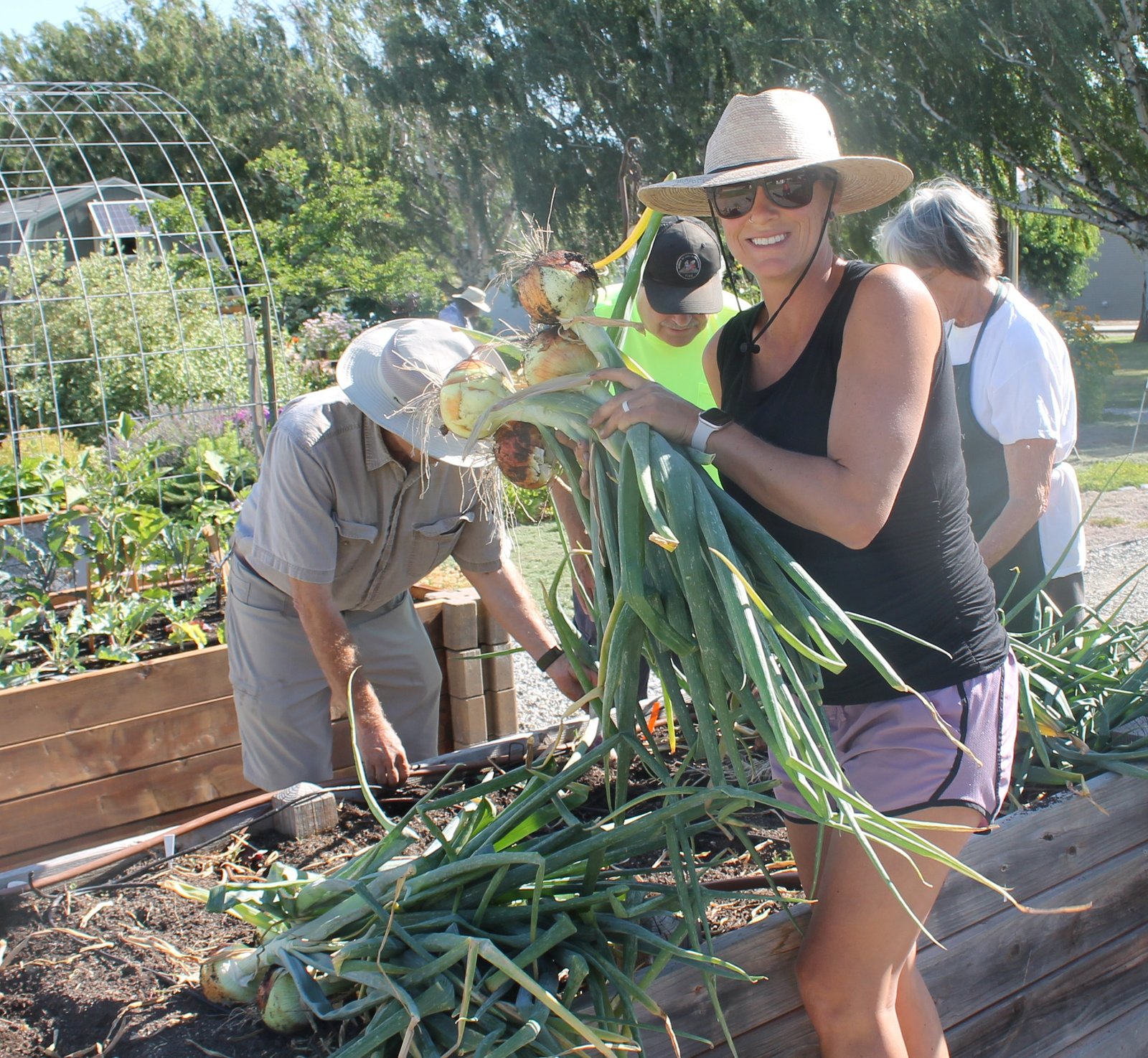
Every spring, I stand in front of the rows of colorful seed racks in the hardware store, intently reading the information on the back of the seed packets. With a wide selection of varieties packed by multiple companies, choosing what to plant is never easy, but with some vegetables, making the right choice is especially important. To raise a successful crop of onions, take care to pick carefully.
Onion plants are biennial, which means that in their first year of life, they grow leaves that produce the carbohydrates they need to survive the winter. This energy is stored up in a swelling at the base of the leaves, better known as the bulb. After vernalizing over a cool winter, the bulb bolts in the following season, sending up stiff flower stalks to produce new seeds before the plant dies.
Onions were domesticated over 4,000 years ago in Central Asia, where the climate is surprisingly similar to that of Eastern Washington. They love cool spring moisture, hot summers and well-drained soil. You would think that onions would be a cinch to grow, but many of today’s cultivars aren’t adapted to living so far north of the equator.
In onions, bulbs form in response to day length. Photoreceptors in the leaves signal when it’s time for the plant to slow its growth and shift its energy into storage. Short-day onions begin forming bulbs when there are 10 to 12 hours of daylight. Intermediate-day varieties start bulbing at 12 to 14 hours, while long-day onions begin as we approach the solstice, when days are 14 to 16 hours long. Choosing the right type of onion for your location is key.
Here in Central Washington, the March sun is already high enough to induce bulb formation in short-day onions. Seeds still on the rack in the hardware store will never have a chance. Long-day onions will form bulbs in mid-May. If you planted long-day seeds directly in the garden today, they would have just weeks to grow before the sun triggers bulbing.
It takes 10 to 12 leaves for an onion to form a big, sweet bulb. The only way to grow large onions this far north, then, is to buy long-day cultivars and give them a head start. Seeds labeled “long-day variety” can be started indoors in February, then transplanted into the garden when the soil is above 50 degrees Fahrenheit. Seedlings are ready to go outside when they have four to six true leaves. Be sure to let them adjust to the outdoors by hardening them off.
If it’s too late to start them from seed at home, you can also buy long-day onions started from seed elsewhere. Some come rooted in soil, while others are sold as bare-root “starts.” Onion starts take a week or two to re-establish their root systems, but they can buy precious time when the clock is ticking toward May.
A third option is to plant long-day onion “sets.” These are mini onion bulbs that were harvested early, cured, then stored in a cool, dry place over the winter. Although they are easy to handle and less prone to drying out than bare-root starts, they can begin the season confused about their age. If they are too mature or if they spend time in cold temperatures, they can think it’s time to bolt. If that happens, instead of raising plump onion bulbs, you can expect onion flowers and a source of new seeds.
If you want to avoid this race against the sun, there are other non-bulbing onion varieties that are not photosensitive. Leeks and bunching onions (also called green onions or scallions) are grown for their white stems and green tops. They can be sown directly in cool soil and harvested any time. They can also be planted in late summer for a fall crop.
A WSU Chelan and Douglas County Master Gardener column appears weekly in The Wenatchee World. To learn more about your local Master Gardener program, visit bit.ly/MGchelandouglas or call (509) 667-6540.