

Drip irrigation has many advantages over sprinklers
By Lloyd Thompson
WSU Chelan/Douglas County Master Gardener
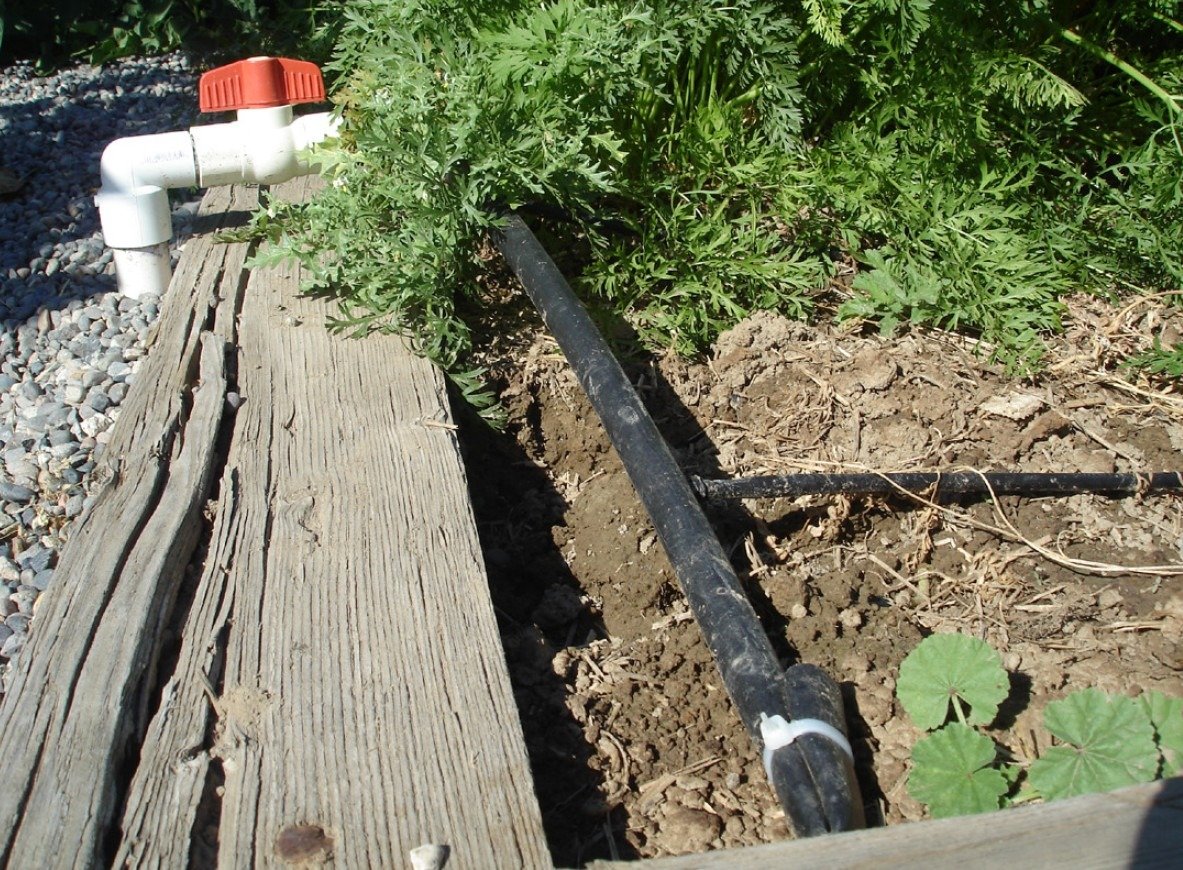

As our warm spring continues, it’s time to make sure every plant is happy and getting enough water. I am going to discuss how using drip irrigation systems can save you water and time, but it still requires some careful planning to get the most out of your investment. This article will focus on drip systems, which work well for gardens, trees, shrubs, flower beds and containers.
The modern drip system using plastic started in the late 1950s and early 1960s. The development of plastic pipe has simplified the installation and expanded the capability of modern drip systems. There are a wide variety of soakers, emitters, bubblers, sprinklers and drip tapes that allow drip systems to meet a wide range of watering requirements for plants. Systems can incorporate a range of emitter types on the same system line to meet the needs of a wide variety of plants.
It’s the efficiency of delivering water that makes drip systems so useful, delivering over 90% of the water used directly to the plants, rather than it evaporating or running off. It also can deprive weeds of broader water applications that they need. Impact sprinklers are lucky to reach 50% to 70% and are greatly affected by wind and evaporation.
The process of installing a drip system isn’t too difficult, and it has a plug and play component that allows you to adjust and tailor the system to fit your water needs over time. I like to purchase my supplies at an established irrigation supply store that has quality components. It saves time and effort over using big box stores that may offer cheaper prices but sometimes lack the component quality, advice and assistance of experienced irrigation sales people. Some factors to consider while planning include your water source and flow rate, water pressure, soil type, plant needs, and site watering limitations.
Drip irrigation systems usually use low pressure (10-30 pounds per square inch (psi) vs 40-60 psi for regular sprinklers) and deliver the water slowly through emitters spaced as needed along the tubing.
A pressure regulator is used to reduce water pressure to an optimal 15-25 psi. Skipping this can result in blowing your emitters off or causing uneven water delivery. You can have a system-wide regulator or individual line regulators depending on your needs and system design.
Filters are used to remove sediment and particles that can clog your emitters and can result in dead plants. I like a larger filter that works on the entire system and then smaller inline filters for extra insurance in preventing clogged lines.
The main line, usually ½-inch or ¾-inch polyethylene tubing, is used to carry the water. This is the “highway” of your system. The longer the line the greater the resistance, but ½-inch black poly pipe is usually sufficient for most home uses. This can be calculated using a flow rate calculation that considers water pressure, emitter volumes and pipe length. Personally, I often use ¾-inch tubing on long runs and distribution lines and ½-inch tubing on single, shorter runs.
The drip line or emitter tubing are pre-installed emitters at a fixed spacing and range from drip tubing, soaker tubing, or drip tape or blank tubing where you insert individual emitters where you need them.
A timer or controller allows regular watering at a time and for a duration that you can select. Choices include battery-operated systems for an in-line hose timer or a multi-station timer that covers an entire system.
There are a lot of useful drip-irrigation-design-and-installation guides available on the internet that cover the basics. A trip to the Community Education Garden that was built and maintained by Chelan Douglas Master Gardeners has lots of drip systems you can look at for ideas. The garden is on the northwest corner of Western and Springwater avenues in Wenatchee.
You can buy “goof” plugs if you decide the emitter location is wrong or add or take away pipe if needed to adjust your system to work the way you want it to. If you are thinking about designing and installing a drip irrigation system, don’t worry; it’s kind of like a puzzle with multiple endings. With a few goof plugs, any mistakes can be easily fixed.
A WSU Chelan and Douglas County Master Gardener column appears weekly in The Wenatchee World. To learn more about your local Master Gardener program, visit bit.ly/wsucdmgprogram or call (509) 667-6540.