

An artificial light in the dark for your indoor plants
By Jenaleigh Fox
WSU Chelan/Douglas County Master Gardener
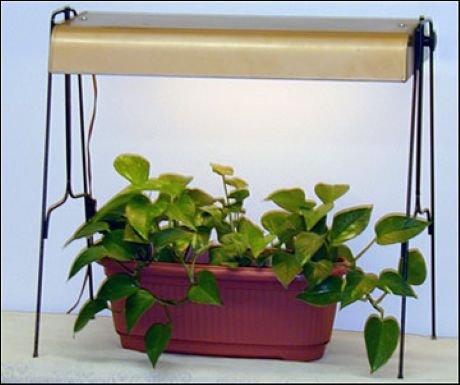

It is the darkest time of year. The winter solstice has come and gifted us with longer days, but it will take months for the sun to come back to us, brazen and blazing in its spring and summertime abundance. We indoor gardeners and our indoor plants need to find a way to survive — even thrive — through this darkness. Cue the artificial lights.
When lighting indoor plants, there are four major considerations: the light needs of the plant, the intensity of light reaching the plant, the quality of light and the duration of light over the course of a day. To give your plant an energy-rich environment, find a bright, full-spectrum grow light, place it 1-2 feet above your plant, put it on a timer and watch it grow.
Plants that can adapt to indoor environments are described as having low, medium or high light requirements. These categories refer to the intensity of light needed for photosynthesis. The familiar Master Gardener principle, “the right plant in the right place,” applies to houseplants, too. Plants with higher light requirements must be placed where they can receive higher light intensity.
You may be familiar with lumens, which measure how much light a bulb produces. Light intensity describes how much of that light reaches a plant. Light intensity is commonly measured in foot-candles (fc), where one foot-candle equals one lumen per square foot. This distinction matters because indoor lighting that feels bright to human eyes, around 300 fc, provides only a small fraction of the more than 10,000 fc intensity plants can experience outdoors. A ceiling light may emit plenty of lumens, but because it is far away and spreads light broadly, very low intensity reaches a plant’s leaves.
Without a sunny window (providing around 5,000 fc), grow lights become essential for medium- and high-light plants. It is possible to get very technical about grow lights — from meters that measure foot-candles, to PPFD, a horticultural measurement of the plant-usable photons reaching a plant each second — but that level of detail isn’t necessary to grow beautiful plants in your home. What matters most is brightness and proximity: a grow light works because it can be placed close to the plant, delivering much higher light intensity where it matters. In general, low-light plants may tolerate ceiling light, but higher-light plants should be placed within 1-2 feet of a bright grow light.
Beyond intensity, the quality of light — the available wavelengths — also matters. Sunlight provides the full spectrum of light, but plants rely on certain wavelengths that can be reproduced by artificial light. Blue wavelengths support leafy growth, while red wavelengths promote flowering and fruiting. The measurement you’ll see on lights indicating color balance is Kelvin (K). At 6500K, “daylight” or “full spectrum” lights will appear cool-white and have a blue-leaning spectrum, great for plant growth.
Among the available bulbs — incandescent, high-intensity discharge, fluorescent and LED —fluorescent and LED lights are the most practical for indoor use as they generate less heat and are more energy efficient. Fluorescents are budget-friendly and can be modified for your plant needs. To support flowering, mixing a lower-Kelvin bulb and a full-spectrum within a multi-bulb fixture would boost red wavelengths among a wide spectrum of light. T5 fluorescent bulbs are the most efficient and come in high-output (HO) options to boost light intensity. LEDs last longer and offer even more flexibility, from red-and-blue-only wavelengths to full-spectrum lights that appear white. Whatever lights you install, you’ll want to be able to move them as the plants grow, especially if you are growing seedlings!
One simple addition to your indoor lighting plan is a light timer. Houseplants need a dark rest period for proper development and should be illuminated for no longer than 16 hours. A timer ensures plants receive enough time in the light and dark. Most common houseplants are day-neutral, meaning they do not require specific day lengths to grow or flower, though some flowering plants, such as kalanchoes, require shorter days to bloom. Here, too, the familiar principle applies: the right plant, in the right place — and on the right schedule. Know your plant’s light needs and give it an energy-rich home with a well-placed grow light.
A WSU Chelan and Douglas County Master Gardener column appears weekly in The Wenatchee World. To learn more about your local Master Gardener program, visit bit.ly/MGchelandouglas or call (509) 667-6540.