

Higher summer temperatures and your tomatoes
By Dana Cook
WSU Chelan/Douglas County Master Gardener

Many gardeners experienced problems with their tomatoes setting fruit last summer. Several WSU Chelan-Douglas Master Gardeners reported a drop or halt in production of the larger varieties in July, while cherry and grape varieties were essentially unaffected. Since production of larger varieties declines above 85 degrees and worsens as temperatures increase above 95 degrees, especially if there are consecutive days of these high temperatures, we wondered if our higher summer temperatures might be a cause of these problems.
We turned to Washington State University’s AgWeatherNet stations. Data can be found at weather.wsu.edu. Historical data is available going back 30 years for the Wenatchee station at the WSU Tree Fruit Research & Extension Center along Western Avenue. The chart that accompanies this column shows how the number of days with a high temperature above 86 degrees has increased during that 30-year span.
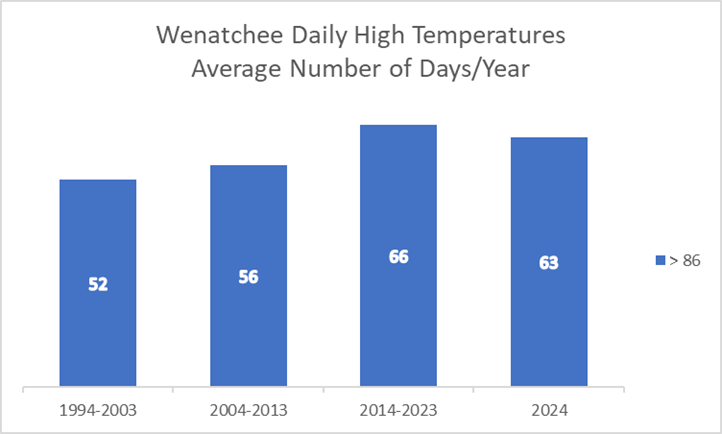
Graphic source: Washington State University’s AgWeatherNet
We are also seeing a greater number of consecutive days above 86 degrees; in 2024, there were 22 consecutive days above 86 degrees in July, followed a week later by 14 consecutive days in the first two weeks of August. Also, 21 of the 31 days in July were above 90 degrees, with temperatures exceeding 95 degrees on 18 days.
While brief periods of high temperature may not have a lasting effect on plant growth and development, several days of these temperatures could stunt growth, cause early or no flowering, as well as lead to fruit loss and leaf drop.
Water is one of the most important factors in helping your garden cope with high temperatures. Ensuring your plants are sufficiently watered during a heat wave can prevent many of the most damaging effects.
To ensure your garden is getting the most benefit from watering, it is best to water early in the day before the temperatures rise to give your plants more time to absorb the moisture before evaporation peaks. It is also best to water the base of the plant, as water droplets on leaves can concentrate light like a magnifying glass and lead to leaf scorching. Mulch can also help maintain moisture and regulate soil temperature. Temporary shade cloth could also help.
To avoid the hottest temperatures, we can plant early tomato varieties, such as Early Girl, that set their fruit before July, especially if they are set out early and protected in the event of a cold snap. We can also use varieties suitable for higher temperatures. Black Krim, Purple Cherokee and Stupice are recommended and have performed well in our area. Varieties bred for hot climates — Heatmaster, Solar Fire, Summer Set, and Phoenix, to name a few — can set fruit even in extreme heat.
While we cannot directly control our summer temperatures, we can mitigate the effects by cultural practices and using suitable varieties. For more information, the WSU Chelan-Douglas Master Gardener Plant Clinic is available to assist gardeners with their questions and problems. You can find Plant Clinic details at bit.ly/mgplantclinic.
Mike Hammer has been a WSU Chelan-Douglas Master Gardener since 2007. He manages the irrigation system at the program’s Community Education Garden along Western Avenue in Wenatchee.
Sources:
Washington State University’s AgWeatherNet, weather.wsu.edu
United States Botanic Garden blogpost by Dr. Destiny Davis, bit.ly/heatzonepost